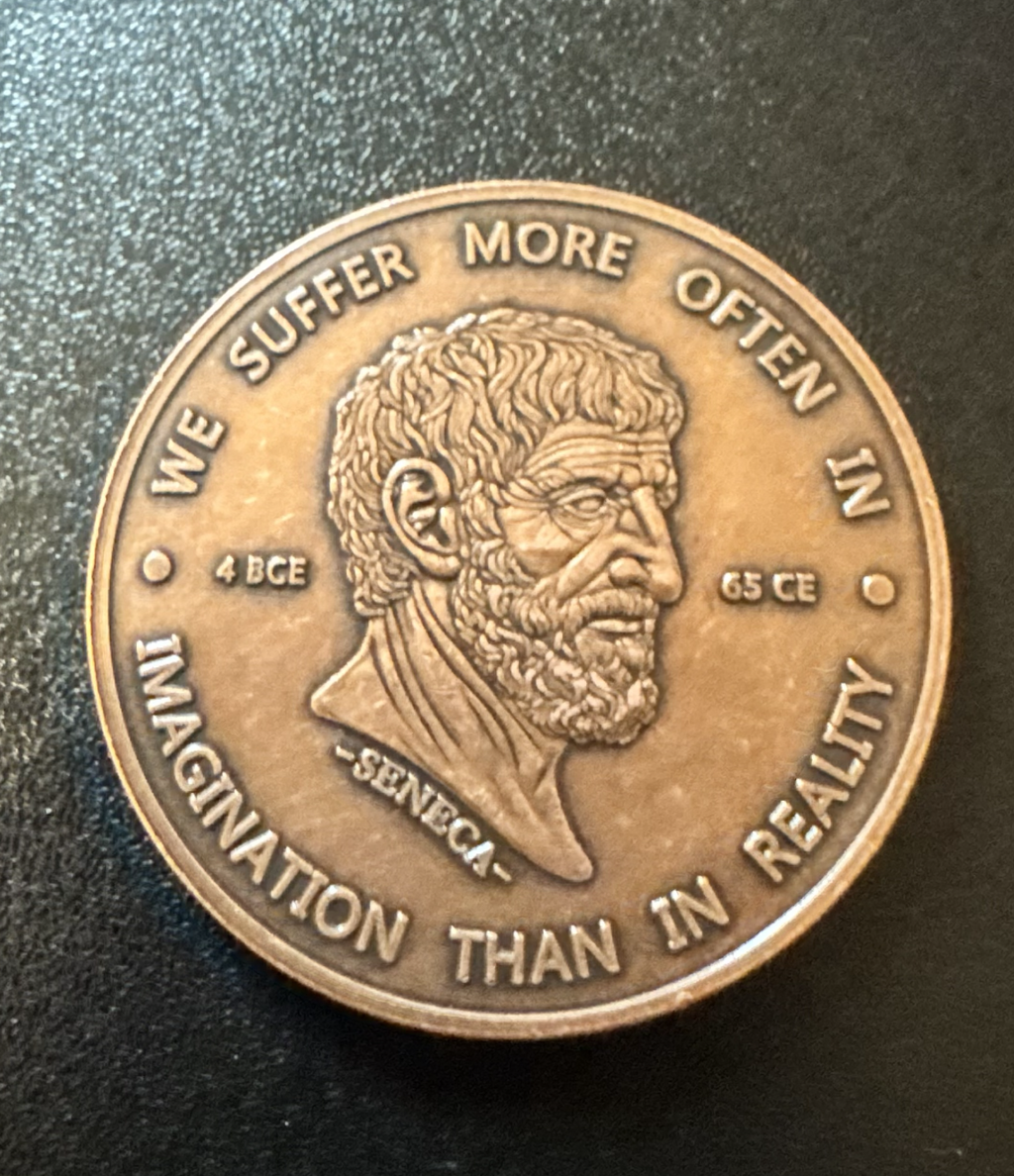
Front
Seneca
The Roman Stoic in profile, beard and furrowed brow. A writer who asked how we use our time, how we meet anger and fear, and what it means to live well.
 1 / 34
A second coin is just $20 more + FREE US shipping.
One for you, one for someone who matters.
Ships in 1 to 2 business days.
Free on orders over $49.
Need it sooner? Choose Priority or Express at checkout.
Depends on your country and its local postal service, not only USPS.
Occasional delays may occur.
Need it sooner? Choose UPS at checkout.
Import fees may apply.
Sending it as a gift?
We print your message on a card and add it to the package, free.
Every coin arrives in its own retail blister, protected and ready to collect or give.

Most of what we fear never happens, and the rest rarely happens the way we pictured it. Seneca wrote this to a friend two thousand years ago. It still lands.
You cannot always choose what happens. You can choose to look at the thought before you believe it.
Change the thought and the weight changes with it. What is left is something you can actually handle.


Seneca wrote to his friend Lucilius about fear, time and what is enough. Press and hold the seal to open one of his letters.
There are more things, Lucilius, likely to frighten us than there are to crush us; we suffer more often in imagination than in reality.
Quotes from the Letters to Lucilius, translated by Richard M. Gummere.
The front names the habit. The back shows the way back to the center.
The Roman Stoic in profile, beard and furrowed brow. A writer who asked how we use our time, how we meet anger and fear, and what it means to live well.

We suffer more often in imagination than in reality. A line from his thirteenth letter to Lucilius, written in a ring around the portrait.

The years on either side of the portrait. His exact birth date is uncertain. 4 BCE is the year often given.

SENECA on a ribbon under the shoulder. Lucius Annaeus Seneca, known as Seneca the Younger.

At the very center of the back. A steady light that stays lit while everything else turns around it.

Spirals circle the flame, like thoughts that turn and turn. However many there are, the flame stays at the center.

Straight lines run out to the edge on both sides, each with a small point. A level horizon when the mind starts to spiral.

We are disturbed not by what happens to us but by our thoughts about what happens. The space between an event and your judgment of it.
Lucius Annaeus Seneca was born in Corduba, today Córdoba in Spain, around the beginning of the Common Era. Educated in Rome in rhetoric and philosophy, he became an orator, a statesman, a playwright and one of the great voices of Roman Stoicism.
For him, philosophy was a practice of everyday life. His letters to Lucilius begin with familiar things: time, friendship, ambition, unease about the future. Reading them, you recognize a mind working on the same questions we meet today.
We suffer more often in imagination than in reality.Seneca, Letters to Lucilius, 13
Examine the thought. Seek clarity. Return to what you can do now.
Lucius Annaeus Seneca, known as Seneca the Younger, was born in Corduba, modern Córdoba in Spain, around the beginning of the Common Era. His exact birth date remains uncertain. Educated in Rome in rhetoric and philosophy, he became an orator, statesman, playwright, and one of the most important authors of Roman Stoicism.
His life brought dramatic changes in circumstance. In AD 41, he was exiled to Corsica, where he remained until 49. After returning, he became the young Nero’s tutor and later one of his advisers. Proximity to imperial power brought influence, but also an increasingly difficult position. In AD 65, accused of involvement in a conspiracy against the emperor, he was compelled by Nero to take his own life. His guilt has not been established with certainty.
His writings explore questions that remain familiar to readers: how we use our time, how we respond to anger, what place we give to money, and what it means to live well. Among his best known works are On the Shortness of Life, On Anger, On Tranquillity of Mind, and the Letters to Lucilius.
In the letters written toward the end of his life, Seneca uses a personal voice and everyday examples to lead readers toward reflection. These texts are also carefully crafted literary works, in which philosophical ideas are tested against recognizable human situations. Readers are invited to think alongside the author and apply what they understand.
At the center of this practice is the Stoic conviction that virtue is the foundation of a good life. Wisdom, justice, courage, and temperance offer guides for our choices. Circumstances matter, but wealth, reputation, or success are not sufficient to define a person’s character.
Seneca himself remains a complex figure. His wealth and career at Nero’s court raise questions about the distance between principles and conduct. An honest biography preserves this tension. The value of his writings can be examined without turning their author into a model free of contradictions.
His legacy is that of a philosophy that asks to be practiced. To examine our fears, observe our habits, value our time, and revisit our mistakes. In this repeated work, readers can find encouragement toward a more conscious and just life.

Die-struck in the USA, then chemically aged so the portrait, the flame and every spiral stand out in relief. Heavy enough that you feel it in your pocket when a thought starts to run ahead.
Antique Bronze and Antique Silver: brass alloy. Antique Copper: solid copper. No two coins are identical; coloring and patina may vary slightly.
The back of each coin, turning together. Drag any coin to turn all three.

Warm gold, like lamplight on an old letter. Our most popular finish.

Cool and calm, like a clear morning. Silver finish on brass alloy.

Solid copper, deep and warm, with a patina that keeps changing with time.
With any coin in your cart, every accessory is $5 less and orders over $49 ship free in the US.


“Love it! Solid craftsmanship and great reminder to not let our thoughts of what might happen control us!”
“Love this coin. It reminds me of what is important in a time where people have more bad answers than good questions.”
“Quality craftsmanship. Would order from them again.”

Your life is what your thoughts make it.

Four virtues, one coin.

Remember you will die.

Your mind, a fortress.

The beginning of wisdom.

Nothing lasts forever.
Mix any designs. Every coin is $5 less from two.
The front reads “We suffer more often in imagination than in reality” around a portrait of Seneca, with 4 BCE, 65 CE and his name. The back reads “We are disturbed not by what happens to us but by our thoughts about what happens” around a flame inside a ring of spirals.
From Seneca’s thirteenth letter to his friend Lucilius. He observes that we often anticipate troubles, enlarge them, or grow distressed before we know whether they will happen.
Lucius Annaeus Seneca was a Roman Stoic philosopher, statesman and playwright, born in Corduba in Spain around the beginning of the Common Era. He was tutor and later adviser to Nero, and wrote On the Shortness of Life, On Anger and the Letters to Lucilius.
When a worry starts to run ahead, hold the coin and ask: what do I truly know right now? Then: what is happening now, what can I do, what support do I need? Sometimes the answer is an action, sometimes patience.
Yes, for anyone who reads the Stoics, tends to overthink, or is facing a big exam, conversation or change. Tick “This is a gift” to add a free printed note.
Antique Bronze and Antique Silver are brass alloy; the silver finish is not solid silver. Antique Copper is solid copper. All three are die-struck in the USA and chemically aged.
Yes. The Seneca Key Tag carries the same portrait, and the Seneca leather sleeve has both sides of the coin engraved in leather. Bought together with a coin, every item is $5 less.
US shipping is free on orders of $49 or more. A single coin ships for $4.99. Add any second item, a coin of any design or an accessory, and every item is $5 less.
Orders ship in 1 to 2 business days. US delivery takes 3 to 5 business days after dispatch, international 14 to 21 days.
Email us at [email protected] within 30 days of delivery. Undamaged items are refunded for the amount you paid; shipping is not refunded. Items bought with a discount code are final sale. Full shipping and returns policy.
Front: a portrait of Seneca with the years 4 BCE and 65 CE and the name SENECA, ringed by “We suffer more often in imagination than in reality.” Back: a flame inside a ring of spirals, with steady lines to the edge, and the words “We are disturbed not by what happens to us but by our thoughts about what happens.”
The front line comes from Seneca’s thirteenth letter to Lucilius, where he observes that we often anticipate troubles, enlarge them, or grow distressed before we know whether they will happen. Together, the two sides invite a pause: look at what is happening, and at the way your thoughts interpret it.
When a worry starts to run ahead, take the coin in your hand and ask: what do I truly know right now? Then three more questions. What is happening now? What can I do? What support do I need? Sometimes the answer is an action. Sometimes it is the patience to wait for information.
Avoid water, chemicals, and prolonged direct sunlight. Store it in its sleeve or display it in a dry place. If needed, clean gently with a soft, dry cloth. No polishing required.
The artwork and design of this coin are original creations, fully protected by copyright and part of the exclusive EDC Reminder Coins collection. Any reproduction, imitation, or unauthorized use is prohibited.
Front: “We suffer more often in imagination than in reality.” (Seneca)
Back: “We are disturbed not by what happens to us, but by our thoughts about what happens.”
Seneca, the Roman Stoic, wrote to his friend Lucilius that we suffer more often in imagination than in reality. Most of the disasters we rehearse in our heads never happen. The back of the coin adds the idea Epictetus taught: what disturbs us is not the event itself but the story we tell ourselves about it.
That makes this a true worry coin. When your mind starts running the worst case, you hold the coin, read the line and ask: is this happening, or am I imagining it?
The front shows a portrait of Seneca with his name and dates, 4 BCE to 65 CE, and the quote around the edge. The back sets the second quote in rings around a small flame at the center, like ripples on still water.
Keep it in the pocket you reach into when you are nervous. Rubbing a coin with your thumb is an old way to calm busy hands, and this one gives your mind something useful to read at the same time. Customers carry it daily. One, an Army veteran of 21 years who knows a good coin, bought it for their son to help him focus.
It is a gentle gift for someone who worries: a student before finals, a friend waiting on test results, a parent who lies awake. It doesn't tell them to stop worrying. It gives them something to hold and a better question to ask.
What is a worry coin?
A small coin you carry and rub with your thumb when you feel anxious. This one adds Seneca's reminder that most of what we fear only happens in our heads.
Did Seneca say “we suffer more often in imagination than in reality”?
Yes. It comes from his Letters to Lucilius, Letter 13.
What is a good gift for someone with anxiety?
Something small and calming they can keep in a pocket. The Seneca Coin is our most popular coin for worriers and overthinkers.
For keys: Seneca Key Tag.
Care: keep it dry and wipe it with a soft cloth. No polishing needed; the aged finish is part of the look.
Original design by EDC Reminder Coins, protected by copyright. We don't take custom orders.
AI guidance for choosing a coin. Conversations are saved to improve the advisor, so please don't share personal, payment or order details. Privacy policy